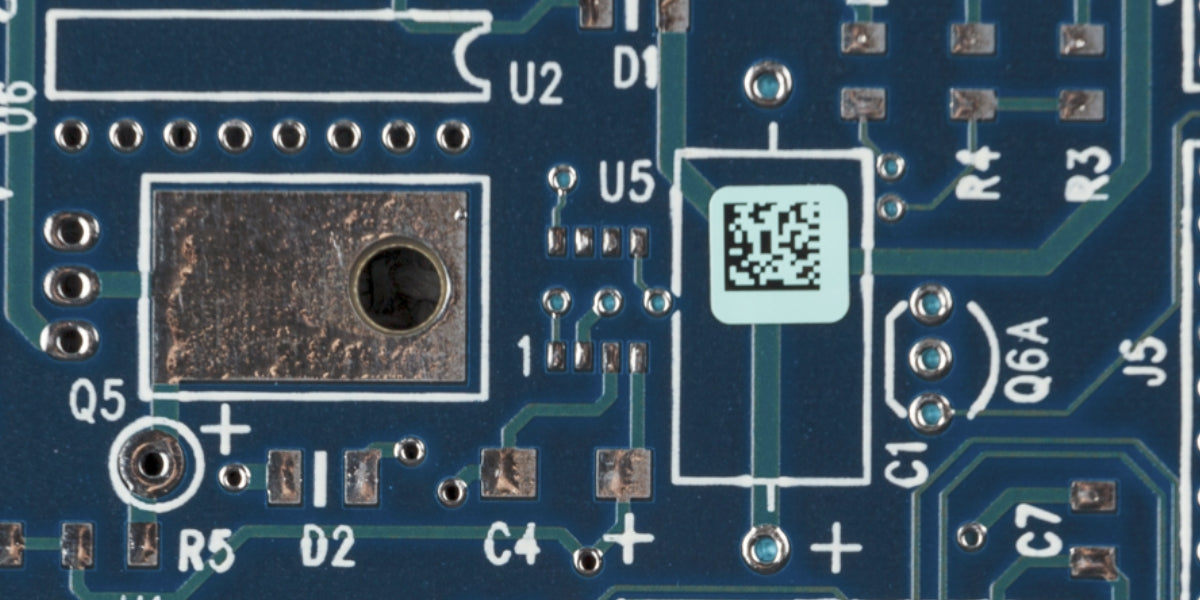
Modern electronics products are becoming increasingly compact. As circuit boards shrink and components become smaller, the space available for identification labels is often extremely limited.
Despite these constraints, manufacturers still need to apply labels containing serial numbers, QR codes or data matrix codes to support product traceability. These codes must remain readable throughout production and the product lifecycle.
Designing labels that are both small and reliably scannable requires careful consideration of barcode size, printing resolution, label materials and scanner capability.
Speak to a labelling expert at Zygology Systems on 01628 520440 or email info@zygology.co.uk.
In this guide
- Why PCB labels are often very small
- QR codes vs traditional barcodes
- Minimum QR code sizes
- Printing resolution and label quality
- Label materials for micro labels
- Scanner capability and verification
- Quiet zones and error correction
- Design considerations for small labels
- QR codes and manufacturing traceability
Why PCB Labels Are Often Very Small
Printed circuit boards often provide very limited space for identification labels. Components, connectors and tracks occupy most of the available surface area, leaving only small areas where labels can be applied.
At the same time, manufacturers increasingly rely on traceability systems that require each board or assembly to carry a unique identifier. This identifier is commonly encoded in a machine-readable format such as a QR code or data matrix code.
As a result, engineers frequently need to design labels that are only a few millimetres across while still containing scannable codes.
In these situations, selecting the correct label construction becomes critical. Even slight distortion of the label during manufacturing can make a small barcode unreadable.
Our guide to why PCB labels fail in electronics manufacturing explains the environmental challenges these labels must often survive.
QR Codes vs Traditional Barcodes
Traditional one-dimensional barcodes encode information using a series of vertical bars. These codes require horizontal space to store data, which makes them less suitable for very small labels.
QR codes and data matrix codes are two-dimensional symbols that store information using a grid of small squares. Because information is encoded both horizontally and vertically, these codes can store much more data within a smaller physical area.
For PCB traceability, data matrix codes are often preferred because they are specifically designed for very small identification marks.
Regardless of which symbol is used, the key challenge is ensuring that the printed pattern remains clear enough for scanners to read reliably.
Minimum QR Code Sizes
The smallest usable QR code size depends on several factors including the amount of data encoded and the resolution of the printing process.
The small squares within a QR code are called modules. Each module must be large enough for scanners to distinguish clearly. If the modules become too small relative to the scanner’s optical resolution, scanning reliability decreases.
For electronics manufacturing environments, codes commonly range from approximately 3 mm to 10 mm depending on the amount of encoded information.
Smaller codes are possible, but they require higher printing resolution and carefully selected label materials.
Printing Resolution and Label Quality
Printing resolution plays a major role in determining how small a barcode or QR code can be.
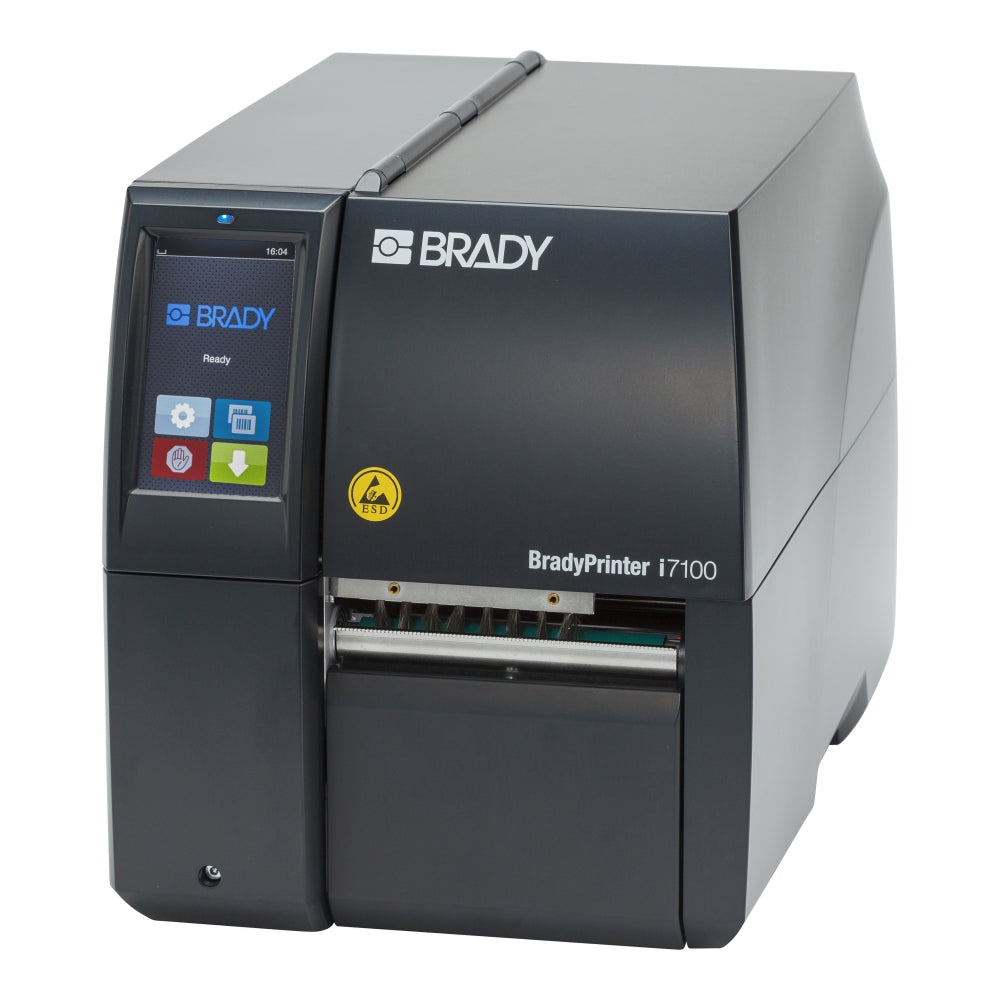
Thermal transfer printers used for industrial labels typically operate at 300 dpi or 600 dpi. Higher resolution printers allow smaller barcode modules to be printed more accurately.
However, printing resolution alone does not guarantee barcode readability. The label material must also remain dimensionally stable so that the printed code does not distort during manufacturing.
This is one reason why high-performance materials such as polyimide labels are commonly used for PCB identification labels.
Speak to a labelling expert at Zygology Systems on 01628 520440 or email info@zygology.co.uk.
Label Materials for Micro Labels
Small labels must remain stable during manufacturing processes such as soldering, cleaning and mechanical handling.
If the label shrinks even slightly, the barcode pattern may distort and scanning reliability can suffer.
For this reason, PCB labels often use materials with excellent dimensional stability.
Polyimide labels are widely used because they tolerate high temperatures while maintaining their shape. This makes them particularly suitable for labels that must survive soldering processes.
Our guide to labels that survive soldering processes explains why high-temperature materials are often required for electronics manufacturing.
Scanner Capability and Verification
The type of scanner used within a manufacturing environment also influences how small a QR code label can be.
Industrial barcode scanners are generally more capable than consumer devices and can read smaller codes more reliably. However, even industrial scanners have limits.
If the barcode modules become too small relative to the scanner’s optical resolution, the scanner may struggle to distinguish the pattern.
For high-reliability environments, manufacturers sometimes use barcode verification systems to confirm that printed codes meet recognised quality standards.
These systems analyse factors such as contrast, edge definition and print distortion. Verification can be particularly valuable when implementing very small identification labels.
Quiet Zones and Error Correction
QR codes require a clear area around the code known as a quiet zone. This blank space allows scanners to identify where the code begins and ends.
If the quiet zone is too small, surrounding graphics or text may interfere with scanning.
This is especially important when designing very small labels where available space is limited.
QR codes also include built-in error correction. This feature allows scanners to recover data even if part of the code becomes damaged or obscured.
While error correction improves reliability, it also increases the density of the code. Designers must therefore balance code size, quiet zone requirements and error correction levels.
Design Considerations for Small Labels
When designing micro labels for electronics manufacturing, several practical considerations should be evaluated.
These include:
- available label area on the PCB
- barcode size and data density
- printer resolution
- scanner capability
- label material stability
Balancing these factors helps ensure that identification labels remain readable throughout manufacturing and during future servicing or maintenance.
Our guide to barcode readability problems in small labels explains several common causes of scanning failures.
QR Codes and Manufacturing Traceability
QR codes and data matrix codes are widely used in modern traceability systems.
By scanning a code on the PCB, manufacturers can link each board to production information such as component batches, test results and manufacturing records.
This improves quality control and allows products to be traced throughout their operational life.
Our guide to how to specify labels for electronics manufacturing explains how traceability requirements influence label design.
Need Help Designing Small QR Code Labels?
Designing reliable micro labels for electronics manufacturing requires careful consideration of materials, printing methods and barcode design.
Speak to a labelling expert at Zygology Systems today:
Call 01628 520440
Email info@zygology.co.uk
Zygology Systems supplies high quality custom labels made in the UK for demanding applications including PCB identification labels and micro barcode labels.